
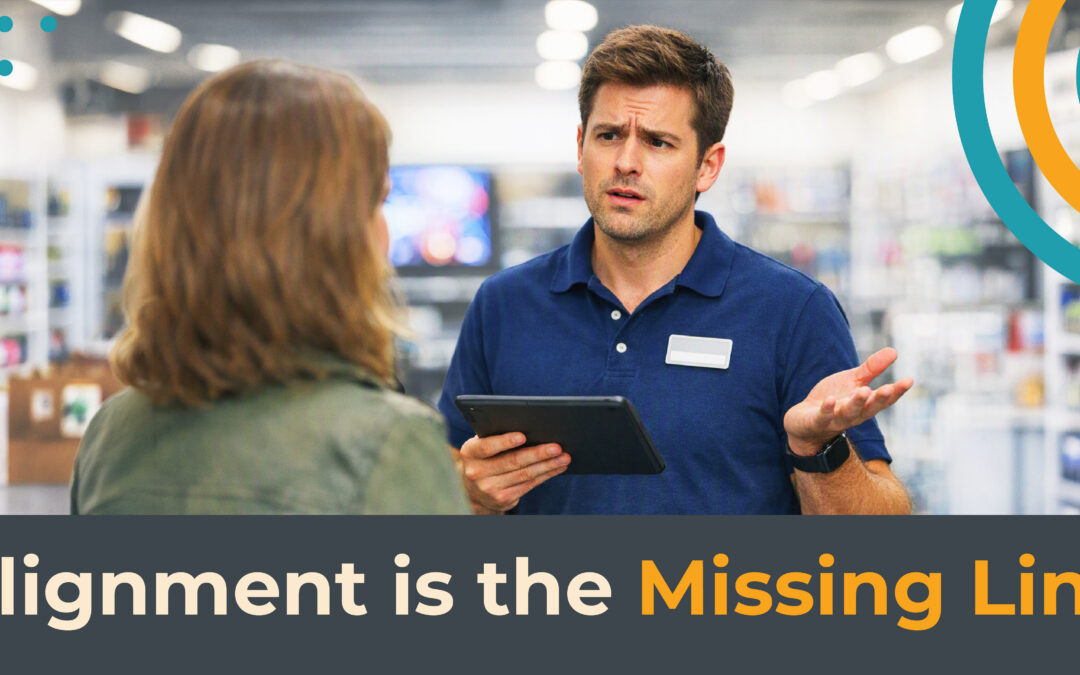
Why Great Retail Strategies Produce Inconsistent Results
In our previous article, we explored why retail associates need access to information in the moment rather than relying solely on memory.
Training creates knowledge, managers reinforce behaviors, performance support enables execution, but even when organizations make information accessible, another challenge remains: How does the right information consistently reach the sales floor in the first place?
This is where many retail initiatives begin to break down. Most retail organizations don't have a strategy problem. They have a translation problem. At headquarters, priorities often feel clear, the launch plans are defined, messaging is aligned, and expectations are communicated. Yet by the time those same priorities reach the sales floor, execution frequently looks different than intended. The issue isn't effort. It's alignment.
The Retail Telephone Game
Most people have played the Telephone Game. One person shares a message. That message gets passed from person to person. By the time it reaches the final participant, it often looks very different from the original version. Retail organizations play their own version of the Telephone Game every day, often without realizing it.
A new initiative may start with a clear objective at headquarters, but before it reaches customers, it often passes through marketing, operations, regional leadership, district management, and store leadership. Every group adds valuable context, but every handoff also creates opportunities for interpretation.
The message rarely changes because someone got it wrong. It changes because every layer of the organization answers a different question. Headquarters asks what should happen. District leaders ask how it affects performance. Store leaders ask how it fits into an already full day. Every translation introduces variation.
Over time, small differences in interpretation begin to accumulate. Details get simplified, context is reduced, and new priorities compete for attention. Individually these changes may seem minor, but collectively they can significantly alter how an initiative is understood and executed.
By the time the strategy reaches the sales floor, execution may no longer resemble the original vision. This is the Retail Telephone Game. It's one of the biggest contributors to inconsistent retail execution.
Why More Communication Doesn't Fix It
The most common response is to increase communication: another email, another update, another document, another meeting. While the intention is understandable, communication volume and execution quality are not the same thing.
In many organizations, communication overload creates the very problem leaders are trying to solve.
As information volume increases, associates and managers often struggle to identify what matters most. Priorities begin to blur together, important messages compete for attention, and the very clarity organizations are trying to create becomes harder to achieve.
Retail organizations rarely suffer from an information shortage. Most suffer from an attention shortage. Every new communication competes with every communication that came before it. Eventually, the challenge isn't getting information to stores. It's helping stores understand what deserves attention right now.
High-performing organizations understand that clarity beats communication volume every time.
The Cost of Misalignment
Misalignment is often treated as an operational issue, but its impact is ultimately commercial. When execution varies, customer experiences vary. Product recommendations become inconsistent, promotions are delivered differently, and brand messaging changes from one location to another.
Over time, those inconsistencies affect sales performance, increase manager workload, reduce the impact of training investments, and weaken confidence in future initiatives. But the cost extends beyond day-to-day execution. Launches lose momentum. Managers spend more time clarifying priorities than coaching behaviors. Teams become overwhelmed by competing messages. And organizations struggle to create predictable outcomes across locations.
Retail leaders rarely budget for misalignment. Yet they pay for it every day through missed opportunities, inconsistent customer experiences, and initiatives that fail to achieve their full potential. The challenge isn't simply inconsistency. The challenge is lost momentum.
Why Retail Initiatives Lose Momentum After Launch
Most retail initiatives begin with energy. Launch plans are clear, leaders are aligned, the stores understand the objective, then reality takes over and new priorities emerge. Additional communications compete for attention. Operational demands increase. Managers are forced to balance multiple initiatives at once.
Over time, focus begins to fragment. The challenge is rarely the strategy itself. It's maintaining alignment as information moves through the organization. Without ongoing reinforcement and clarity around priorities, even well-designed initiatives can lose momentum long before they achieve their intended impact.
How High-Performing Retailers Create Consistency
Leading retailers recognize that execution consistency isn't created through communication alone. It's created through alignment. By establishing clear priorities, reinforcing them consistently, and connecting strategy directly to frontline actions, they reduce interpretation and create a shared understanding of what matters most.
Many organizations measure success by distribution: Was the message delivered?
High-performing retailers measure success differently: Did behavior change?
Information only creates value when it influences execution. That's why the strongest organizations focus less on sending messages and more on creating alignment.
Warning Signs You Have an Alignment Problem
Alignment challenges rarely appear overnight. More often, they surface through patterns that become increasingly difficult to ignore. Common indicators include:
- Strong strategy but inconsistent execution
- Significant store-to-store performance variation
- Frequent requests for clarification
- Competing priorities creating confusion
- Managers spending excessive time translating initiatives
- New programs losing momentum shortly after launch
- Different customer experiences across locations
These issues are often treated as communication problems. In reality, they are usually signs of an alignment problem. Recognizing them early helps organizations address the root cause before inconsistency becomes embedded in daily operations.
Alignment Is The Missing Link
Retail performance rarely breaks down because organizations lack good ideas. Most retailers have strong strategies, talented leaders, and capable teams. The challenge is ensuring those strategies survive the journey from headquarters to the sales floor. Every additional handoff creates opportunities for interpretation. Every competing priority increases the risk of confusion. Every new communication competes for limited attention.
This is why execution consistency remains one of the biggest challenges in retail operations. The organizations creating the strongest customer experiences understand a simple truth: Execution is not a communication problem. It is an alignment problem. Training creates knowledge. Managers reinforce behaviors. Performance support enables execution. Alignment ensures all three move in the same direction.
The retailers that win aren't necessarily communicating more. They're creating stronger connections between strategy and execution. And that's where retail performance becomes scalable.
Download the Execution Gap Assessment to identify alignment challenges, uncover execution barriers, and create more consistent retail performance across every location.
Frequently Asked Questions
Why do retail initiatives fail?
Retail initiatives often fail because priorities and expectations become distorted as they move through different layers of the organization. The issue is typically alignment, not strategy.
What causes execution gaps between HQ and stores?
Execution gaps occur when information, priorities, and expectations change between headquarters, regional leaders, managers, and frontline employees.
Why do stores execute differently?
Stores often receive the same information but interpret priorities differently based on local leadership, competing initiatives, staffing realities, and communication volume.
Why doesn't more communication improve execution?
More communication can increase complexity and information overload. Execution improves when organizations create clarity, alignment, and engagement rather than simply increasing communication volume.
How do retailers improve execution consistency?
High-performing retailers improve consistency by aligning priorities, enabling managers, reinforcing learning, providing performance support, and ensuring frontline employees understand how initiatives connect to customer interactions.