
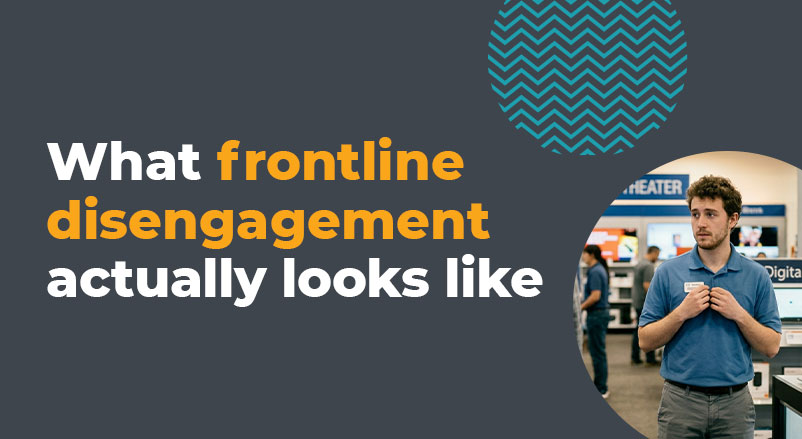
Why Operational Friction Is Quietly Hurting Performance, Retention, and Revenue
Most frontline disengagement does not start as a culture problem. It starts as an operational signal.
A manager spends more time covering shifts than coaching employees. Customer experience scores fluctuate between locations. Same-store sales remain inconsistent despite increased training investment. Teams complete learning modules, but frontline execution still feels disconnected.
At first, these issues seem unrelated. Operationally, they are deeply connected. For frontline organizations, disengagement rarely appears as one obvious business problem. It spreads quietly across turnover, productivity, execution consistency, customer experience, and sales performance all at the same time. And because those costs show up across multiple departments, many organizations underestimate how expensive disengagement actually becomes.
This is where companies often misdiagnose the issue.
They treat disengagement as a morale problem or HR initiative when, in reality, it is often the result of operational systems creating friction instead of supporting frontline performance.
That distinction matters. Because if disengagement is being operationally created, it must also be operationally solved.
What Frontline Disengagement Actually Looks Like
One of the biggest misconceptions around engagement is the belief that disengaged employees simply care less.
Operationally, that is rarely what happens first.
Based on patterns across more than 500,000 unique active frontline learners, disengagement is more commonly tied to friction than motivation.
Frontline teams disengage when:
- Expectations constantly shift
- Communication becomes overwhelming
- Training feels disconnected from real work
- Managers lack time to coach effectively
- Reinforcement disappears after learning
- Employees do not feel supported in execution
The warning signs usually appear operationally long before they show up in survey data.
Managers repeat instructions constantly. Teams stop proactively engaging customers. Execution quality varies between locations. Employees begin focusing on task survival instead of performance improvement.
Over time, friction replaces clarity.
And when employees no longer feel confident in execution, engagement naturally declines alongside performance.
The Five Financial Impacts You’re Already Paying For
Impact #1: Turnover Costs Multiply Quickly
When experienced frontline employees leave:
- Managers shift into constant hiring mode
- Team consistency declines
- Remaining employees absorb additional workload
- Productivity drops during onboarding periods
- Coaching quality becomes inconsistent
Across large retail and frontline organizations, even modest increases in turnover quietly create significant operational strain.
And the longer turnover continues, the harder it becomes for teams to maintain execution consistency at scale.
Impact #2: Shrink and Operational Leakage Increase
Disengagement weakens attention to detail.
Store standards begin slipping. Accountability becomes inconsistent. Small operational misses turn into measurable financial leakage across inventory, compliance, and customer experience.
These problems rarely happen because employees intentionally underperform.
More often, they happen because overwhelmed teams lose clarity around priorities, ownership, and expectations.
Impact #3: Customer Experience and Sales Conversion Decline
Disengaged teams stop creating meaningful customer interactions.
Service becomes transactional. Employees focus on completing tasks instead of building customer confidence. Upsell opportunities become inconsistent. Product recommendations lose energy and conviction.
At scale, those moments directly impact:
- Conversion rates
- Average transaction value
- Same-store sales
- Customer loyalty
- Brand perception
Many organizations continue investing heavily in customer experience strategies while overlooking the operational reality underneath them:
Disengaged frontline teams struggle to consistently deliver strong customer experiences.
Impact #4: Productivity Friction Slows Execution Across Teams
Operational friction compounds daily.
Managers repeat the same instructions across locations. Communication gaps create inconsistent execution. Errors require rework. Teams spend more time reacting operationally than improving strategically.
This is where disengagement becomes especially expensive.
The cost rarely appears as one catastrophic failure. It appears as thousands of small inefficiencies slowing execution every single day across the business.
Impact #5: Recruiting and Employer Reputation Become More Difficult
Disengagement no longer stays internal.
Customers share poor experiences publicly. Employees share frustrations online. Recruiting becomes harder as turnover increases and workplace reputation weakens.
Over time, organizations enter a cycle where:
- Turnover increases operational strain
- Operational strain increases disengagement
- Disengagement weakens retention
- Retention issues increase recruiting difficulty
Without intervention, the cycle reinforces itself.
Why More Training Alone Often Fails
One of the biggest mistakes organizations make is responding to performance gaps with more content. More training does not automatically create better execution.
In many cases, it creates more overload.
Frontline employees already operate in high-speed environments filled with competing priorities, fragmented communication, and limited coaching support. Adding additional learning requirements without operational reinforcement often increases frustration instead of improving confidence.
This is the difference between traditional training delivery and engagement-first enablement.
Traditional learning systems focus heavily on content completion.
High-performing frontline organizations focus on:
- Clarity
- Reinforcement
- Motivation
- Coaching support
- Execution confidence
- Real-world application
Because frontline performance improves when employees feel supported operationally, not simply informed.
Early Warning Signs Leaders Often Miss
Turnover Signals
- Rising early-tenure attrition
- Increased manager burnout
- Declining internal promotions
- High turnover concentrated under specific leaders
Customer Experience Signals
- Inconsistent service feedback
- Lower satisfaction scores
- Reduced proactive customer engagement
- Increased complaints around responsiveness
Sales Performance Signals
- Flat same-store sales despite training investment
- Strong traffic with inconsistent conversion
- Lower attachment and upsell rates
- Uneven execution between locations
The challenge is recognizing these signals early enough to solve them strategically instead of reactively.
Engagement Must Be Built Into Operational Strategy
At Halight, this philosophy is embedded into The Halight Current — a performance-driven framework designed to reduce operational friction, strengthen frontline enablement, and improve execution consistency across large frontline organizations.
Because frontline teams perform differently when:
- Learning feels connected to real work
- Reinforcement feels achievable
- Managers are equipped to coach consistently
- Operational systems support execution instead of complicating it
Organizations that improve frontline engagement strategically often improve:
- Participation
- Retention
- Frontline confidence
- Sales performance
- Customer experience
- Operational consistency
The goal is not simply to train more.
The goal is to create energized frontline teams capable of performing consistently at scale.
When engagement becomes part of operational strategy, participation, performance, and frontline execution improve alongside it. Book a consultation with us today to start improving your organization’s frontline performance.
Frequently Asked Questions
What causes frontline employee disengagement?
Frontline disengagement is often caused by operational friction rather than employee attitude alone. Constantly shifting expectations, disconnected training, overwhelming communication, limited coaching support, and inconsistent operational systems all contribute to declining engagement.
How does frontline disengagement affect business performance?
Disengagement impacts turnover, productivity, sales conversion, customer experience, execution consistency, recruiting, and operational efficiency simultaneously. Over time, these operational inefficiencies compound significantly across large frontline organizations.
Why doesn’t more training automatically improve engagement?
More training alone can increase frustration when employees already feel operationally overwhelmed. Frontline teams need reinforcement, clarity, coaching support, and enablement systems that improve execution confidence in real-world environments.
What are the early warning signs of disengaged frontline teams?
Common indicators include rising turnover, inconsistent execution across locations, declining customer satisfaction, reduced sales conversion, operational shortcuts, lower coaching quality, and uneven frontline performance between teams or managers.
How can organizations improve frontline engagement?
Organizations improve engagement by reducing operational friction, strengthening manager support, improving communication clarity, reinforcing learning consistently, and connecting enablement directly to frontline execution and business outcomes.