
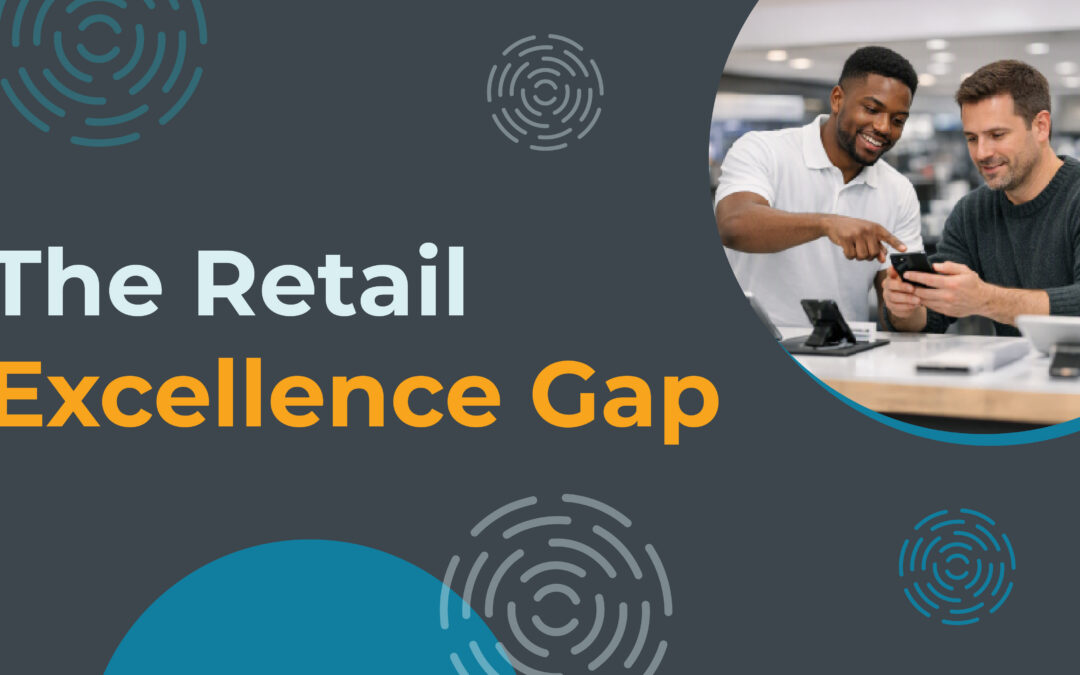
The Excellence Gap
In our previous article, we explored why high-performing retailers reduce their dependency on tenure. When performance depends on employee longevity, every seasonal hiring cycle, product launch, or staffing change introduces unnecessary risk.
The strongest organizations solve that problem by building systems that help new associates become productive faster. Even organizations that successfully reduce tenure dependency encounter another challenge. Some associates still outperform everyone else. They consistently build stronger customer relationships, earn higher attachment rates, create greater customer confidence, and convert more opportunities into sales.
Every retailer knows who these people are. The real question isn't why they succeed. It's why their success so often stays with them.
At Halight, we call this The Excellence Gap. The distance between what your best associates consistently achieve and what the rest of your organization is able to reproduce. If exceptional performance exists in only a handful of individuals, your organization doesn't have a competitive advantage. It has a dependency problem.
Why Top Performers Continue to Pull Ahead
It's tempting to believe top performers simply possess natural talent, that they're better communicators, more charismatic, or more experienced. While those qualities can certainly influence performance, they rarely explain sustained success on their own.
The highest-performing retail associates consistently demonstrate behaviors that can be observed, coached, and reinforced. They prepare before customer conversations, ask better questions, connect product knowledge to customer outcomes rather than product features, and build confidence instead of creating pressure. Most importantly, they create trust.
Customers don't remember every specification they hear. They remember how confident they felt making a decision. That confidence is what exceptional associates consistently create. The encouraging news is that these behaviors aren't random, they leave patterns, and patterns can be scaled.
The Hidden Cost of Individual Excellence
Top performers often become the standard every organization wants to replicate, but they can also unintentionally hide operational weaknesses.
Managers rely on them to mentor newer employees.
Customers seek them out by name.
They consistently recover difficult situations.
They deliver exceptional results despite inconsistent systems.
On the surface, that appears to be a success story. In reality, it creates a hidden dependency.
If only a small percentage of associates consistently deliver exceptional customer experiences, organizational performance remains fragile. When those employees leave, change roles, or become unavailable, performance often declines with them.
That's why the goal isn't simply developing exceptional people. The goal is creating an organization where exceptional performance becomes repeatable.
Success Leaves Clues
One of the biggest mistakes retail organizations make is celebrating top performers without studying them.
Recognition matters, but replication creates growth.
Leading retailers don't ask: "Who are our best associates?"
They ask: "What behaviors consistently produce our best results?"
That shift changes everything.
Instead of viewing excellence as personality-driven, they begin identifying repeatable patterns.
- How do top performers open conversations?
- How do they uncover customer needs?
- How do they build trust?
- How do they recommend solutions with confidence?
- How do they handle uncertainty?
Those behaviors become teachable. Coachable. Repeatable. Once they become repeatable, they stop belonging to one individual and start strengthening the entire organization.
Exceptional Performance Doesn't Happen by Accident
Throughout this series, we've explored the challenges that prevent knowledge from becoming consistent frontline performance.
We've looked at:
- The Revenue Activation Gap
- The Manager Multiplier Effect
- The Knowledge Access Gap
- The Retail Telephone Game
- The Advocacy Advantage
- Quality Drift
- The Tenure Dependency Problem
- The Excellence Gap
Each represents a different obstacle standing between strategy and execution.
Viewed independently, they can feel like separate operational challenges.
Viewed together, they reveal something much bigger.
High-performing retail organizations don't outperform because they train more.
They outperform because they've built a connected performance ecosystem where knowledge is reinforced, managers amplify the right behaviors, information is accessible when it's needed, communication stays aligned, advocacy creates trust, systems preserve quality, and exceptional behaviors become repeatable across every store.
That's the foundation of The Halight Current.
It's not a single training program or technology.
It's a framework for turning learning into measurable business performance.
Because sustainable growth isn't created by a handful of exceptional associates.
It's created when exceptional performance becomes the standard.
If you're evaluating how your organization develops, supports, and scales frontline performance, explore The Halight Current to see how these concepts work together to create stronger customer experiences, more confident associates, and consistent execution at scale.
Download the Excellence Gap Playbook to learn how to turn top performer behaviors into team-wide success.
Frequently Asked Questions
What makes top-performing retail sales associates different?
Top-performing associates consistently demonstrate behaviors that build customer confidence, establish trust, and connect product knowledge to customer needs. While experience can help, their success is typically driven by repeatable behaviors that can be observed, coached, and reinforced across an organization.
Can top sales performance be taught?
Yes. Although every associate has unique strengths, the behaviors that contribute to exceptional retail performance are often repeatable. Organizations that identify, reinforce, and coach these behaviors are better positioned to improve consistency and scale performance across teams.
Why do some retail stores consistently outperform others?
High-performing stores rarely depend on individual talent alone. They create systems that reinforce effective behaviors, provide ongoing coaching, and make best practices repeatable across locations. This reduces performance variability and improves customer experience.
How can retailers scale the success of their top performers?
The most successful retailers study what their highest-performing associates do differently, identify common patterns, and build enablement programs that help every associate adopt those behaviors. The goal is to transform individual excellence into organizational capability.
What is the Excellence Gap?
The Excellence Gap is the difference between what an organization's top-performing associates consistently achieve and what the broader workforce is able to replicate. Closing this gap requires more than training—it requires coaching, reinforcement, performance support, and systems that make exceptional behaviors repeatable at scale.