
Executive Summary
Retail advantages do not last as long as they used to. Products are quickly imitated. Prices are instantly compared. Campaigns are visible to everyone.
The harder advantage to copy is the ability to move quickly and consistently from strategy to store-level action.
That is why retail execution is becoming more valuable. The brands gaining an edge are not simply making better plans. They are building organizations that can put those plans into motion faster, learn from the sales floor and adjust before competitors catch up.
What Is Retail Execution?
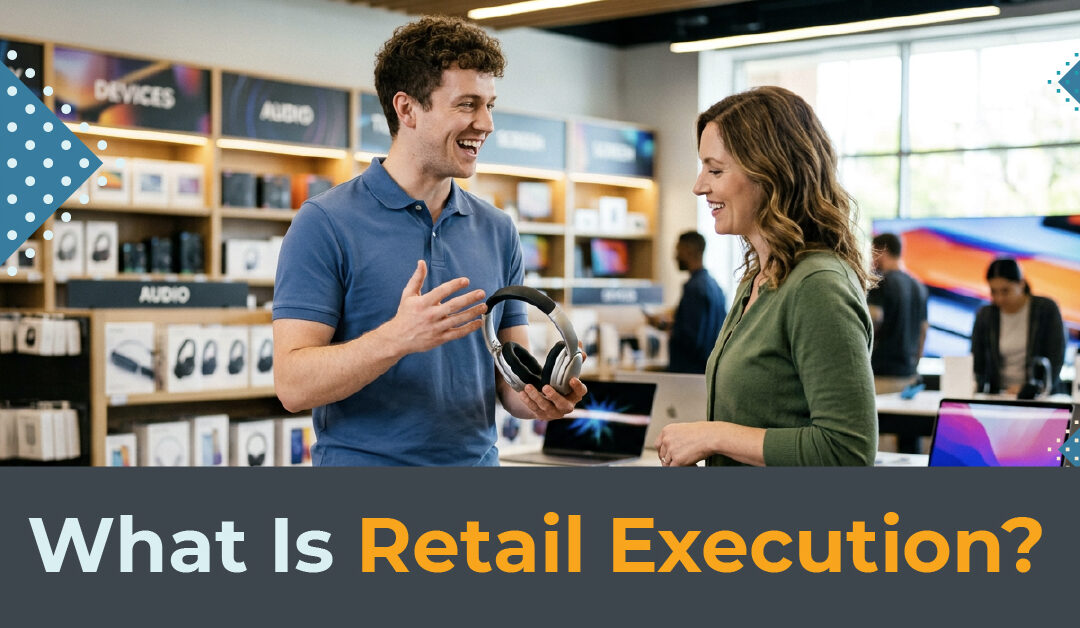
Retail execution is a brand’s ability to turn strategy into consistent action across its retail network.
It is what happens between the decision made at headquarters and the moment a customer encounters that decision in a store.
A new product can be brilliant. A campaign can be compelling. A retail partnership can be strong. But none of those advantages reach their full potential unless the people closest to the customer know what changed, why it matters and what to do next.
The Shelf Life of Advantage Is Shrinking
Retail has always moved quickly. What has changed is how quickly competitors can respond.
A new product feature can be studied and replicated.
A pricing move can be matched.
A promotion can be countered.
A campaign idea can inspire ten variations.
The window between introducing something different and watching the market catch up is getting smaller.
That changes the question.
It is no longer just: Do we have a strong strategy?
It is: How quickly can the entire retail network act on it?
What We’re Seeing
The execution gap often appears in the handoff.
Headquarters launches.
Marketing promotes.
Sales aligns partners.
Training distributes information.
Then thousands of people across different stores, regions and roles have to make it real.
That is where momentum can disappear.
Not because the strategy was wrong, but because:
The message changed as it moved through the organization.
Store teams received information without enough context.
Local questions surfaced after the rollout was already underway.
Some locations adapted quickly while others fell behind.
Insights from the sales floor arrived too late to influence the plan.
Individually, these gaps may look small.
At scale, they can determine whether a strategy gains momentum or stalls.
Retail Reality Check
A strong strategy does not create an advantage on its own.
The advantage comes from how quickly and consistently the organization can act on it.
The best retail organizations are not just good at launching.
They are good at moving.
The Execution Advantage
Strong retail execution creates a faster cycle:
DECIDE → ACTIVATE → OBSERVE → ADAPT
Decide
The organization sets a clear priority.
Activate
The people closest to the customer understand what matters and what action to take.
Observe
The organization can see what is working, where friction is appearing and what the frontline is experiencing.
Adapt
The strategy improves while the opportunity is still active.
Then the cycle begins again.
The advantage is not perfection.
It is the ability to move, learn and improve faster than the market around you.
Where High-Performing Brands Pull Ahead
The biggest execution gains often happen in the space between departments, systems and people.
High-performing brands reduce that distance.
They make it easier for:
Strategy to reach the frontline without losing meaning.
Store-level feedback to travel back to decision-makers.
Teams to respond while an opportunity is still relevant.
Successful behaviors to spread across locations.
Leaders to see where momentum is building or breaking.
This creates something competitors cannot easily buy or copy: organizational responsiveness.
Questions Every Retail Leader Should Ask
Before your next major initiative, ask:
- How many handoffs stand between this decision and the customer?
- Where is the message most likely to lose clarity?
- How quickly will we know if stores are struggling?
- Can frontline feedback influence the initiative while it is still active?
- If one location finds a better way, how quickly can the rest of the network learn from it?
The answers reveal more than whether a launch is ready.
They reveal how well the organization is built to execute.
One Action This Week
Take one current retail initiative and map every handoff between the original decision and the customer.
Where does momentum slow down?
That point may be more important than the strategy itself.
The Halight Perspective
The next era of retail will not belong only to the brands with the biggest budgets, the newest technology or the most ambitious strategies.
It will belong to the brands that can move.
The ones that can turn decisions into action, see what is happening across the retail network and respond while the opportunity still matters.
Because when every advantage has a shorter shelf life, the ability to execute becomes an advantage of its own.
Continue the Conversation
Where does momentum slow down between strategy and the sales floor?
Share your perspective. We are collecting insights from retail leaders for future editions of the Field Report because the strongest view of retail performance rarely comes from one vantage point alone.
Want to explore more? Visit the Halight Resource Center.
Download the Retail Execution Scorecard.