
Picture this: Your employee clicks into a mandatory training module on a Tuesday afternoon. Forty-five minutes of content stands between them and their mounting inbox. They are juggling urgent projects. Slack is pinging. A deadline is looming. The module loads. Generic scenarios unfold. The progress bar moves. They click “complete,” close the window, and immediately return to real work.
Nothing changes.
This is the L&D Energy Crisis in action, and it is costing organizations more than most leaders realize. Across industries, companies invest heavily in training platforms, learning libraries, and new programs designed to improve capability. Yet employee training effectiveness continues to lag behind expectations, and measurable performance improvement rarely follows.
What Is the L&D Energy Crisis?
The L&D Energy Crisis is the growing disconnect between corporate training delivery and measurable business outcomes. It shows up as low engagement, weak retention, minimal skill application, and unclear learning and development ROI.
Most organizations are not short on training. They are short on training that feels relevant, usable, and worth the time.
That gap creates a predictable moment. A learner opens a module and thinks, “How does this help me do my job better?” When training cannot answer that question quickly, employee training effectiveness drops. Engagement becomes compliance. Completion becomes the goal. Performance remains unchanged.
Content exists. Platforms exist. Budgets exist. But learning energy is missing.
Energy is not hype. It is the combination of clarity, motivation, and momentum that moves people from passive learning to active performance.
Without energy, training becomes noise.
The Voices Behind the Crisis
We consistently hear the same themes from learners:
“I often wonder what the point of all this information is if it has nothing to do with my actual job.”
“I’m not sure what problem this training is solving for me or my team.”
“I’m checking boxes, but I don’t feel set up for success.”
These are not resistant employees. They are capable people asking for relevance.
The problem is not effort.
It is not intelligence.
It is not attention span.
It is design.
The Real Problem: It Is a System Issue
Conventional wisdom blames shrinking attention spans. That explanation is convenient, but wrong. People focus when something matters to them. They invest time when the value is clear.
The L&D Energy Crisis is driven by four systemic patterns that undermine modern learning and development strategy.
Content First, Outcomes Second
Training becomes content-first instead of outcome-first. Libraries grow. Relevance shrinks. Without a clear connection to business outcomes, content volume increases while employee training effectiveness declines.
Completion Metrics Replace Performance Metrics
Employee learning engagement is measured by completion rates instead of performance movement. Activity is mistaken for impact.
No Clear “What’s In It For Me”
Learners consume information without a clear connection to their work or growth. Intrinsic motivation weakens.
Knowledge Without Application
Training stops at knowledge transfer. Information is delivered, but application, practice, and reinforcement are missing.
At Halight, we see this pattern across industries. The problem is rarely budget. It is rarely intent. It is almost always alignment, motivation, and application.
Introducing Energized Learners
The solution begins with energized learners.
Energized learners are engaged, motivated, and invested because training connects directly to their work and their growth. They understand why learning matters. They see how success is defined. They are given opportunities to apply skills in real situations.
This is not about personality. It is about system design.
When learning is intentionally designed to fuel capability, ignite motivation, and empower action, energy becomes predictable, not accidental.
An energized learner does not just complete training. They translate learning into performance.
When learners are energized:
Teams become more productive
Collaboration improves
Retention strengthens
Performance conversations become clearer
Learning and development ROI becomes measurable
If energy is missing, even strong content will struggle to produce results.
The Structural Shifts Redefining L&D
Four structural shifts are forcing learning and development strategy to evolve.
From Training Delivery to Performance Enablement
L&D is expected to connect learning initiatives to measurable business impact. Employee training effectiveness is no longer defined by courses delivered. It is defined by capability built and performance improved.
From Generic Content to Personalized, Point-of-Need Learning
Learners expect training aligned to their role, context, and timing. Generic content libraries become content graveyards when they lack relevance.
From Technology Hype to Strategic Integration
Technology amplifies strategy. It does not replace it. Without alignment, technology scales inefficiency.
From One-Time Events to Continuous Learning Ecosystems
Organizations need steady reinforcement, short learning cycles, real practice, and feedback loops to sustain performance growth.
The Shift: From Compliance to Performance Activation
Fixing the L&D Energy Crisis requires a deliberate shift in how learning is designed, communicated, and measured.
Apply this three-question filter to every learning initiative.
Alignment: Does this training support a strategic business outcome?
Motivation: Does it clearly answer “what’s in it for me” and create intrinsic engagement?
Application: Does it include hands-on practice, feedback, and measurable performance improvement?
When those answers are yes, energy rises. Engagement rises. Performance rises.
This is performance activation, not compliance.
Why We Built the Halight Current
The L&D Energy Crisis is not solved with more content.
It is solved with clarity, energy, and intentional design.
That is why we built the Halight Current.
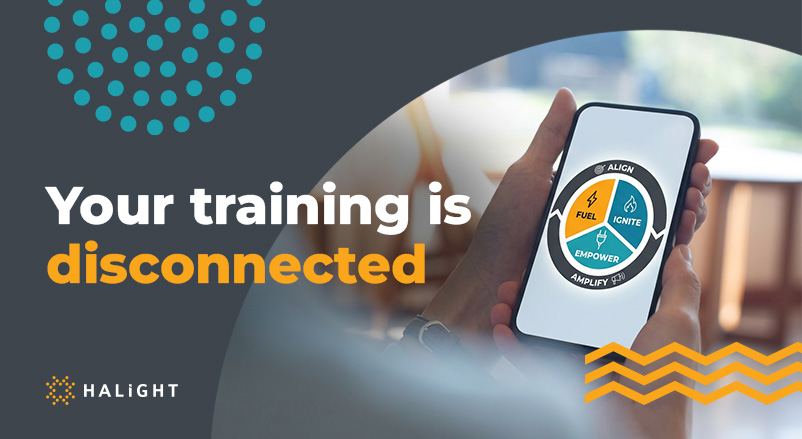
A performance-based framework designed to move organizations from training delivery to measurable transformation.
Fuel builds capability.
Ignite activates engagement.
Empower drives application.
Align sets direction.
Amplify sustains momentum.
Together, these components create energized learners and scalable performance impact.
In the next article, we break down how the Halight Current works as an integrated system and how to move from activity metrics to measurable transformation.
Ready to solve the L&D Energy Crisis?
Download the complete Halight Framework and start building a learning system that fuels people, ignites motivation, and empowers measurable performance.
Frequently Asked Questions
What is the L&D Energy Crisis?
The L&D Energy Crisis occurs when training activity exists but performance improvement does not because learning lacks alignment, motivation, and measurable application.
What causes low employee training effectiveness?
Low employee training effectiveness is caused by irrelevant content, weak alignment to business outcomes, poor motivation design, lack of practice, and measuring completions instead of performance.
Who are energized learners?
Energized learners are individuals who engage with learning because it is relevant, motivating, and intentionally designed for real-world application and measurable growth.
How do you increase learning and development ROI?
Increase learning and development ROI by aligning training to strategic outcomes, designing for intrinsic motivation, building application pathways, and measuring business impact.
What is the first step to fixing the L&D Energy Crisis?
The first step is alignment. Define measurable business outcomes, then design learning around relevance, motivation, and application tied directly to those outcomes.